

INQUISITOR: A historical horror novel series
Everything they told you as a child is true.
When you were a child, they told you not to go out onto the roads at night. They warned you that the bogeyman took those who couldn't sleep, that you should never accept a candle offered by a stranger in the dim light, and that witches don't exist—but they are out there anyway. They repeated to you that there is gold buried in the ancient hillforts, and that something monstrous and hungry guards it in the dark.
They told you all of this to scare you, to keep you safe by the fireside. But no one told you the most terrible truth: all of it was real.
In mid-17th century Santiago de Compostela, it is. The year is 1649, and the kingdom is agonizingly bleeding to death on the border due to the war with Portugal. Hunger tightens its grip on the coastal villages, the fields are left empty, and a dense, grey fog never seems to fully lift. On long autumn nights, what has always lived in old wives' tales takes to the roads.
The townspeople know it. They nail gorse branches to their doors to protect their homes, whisper their prayers, and prefer not to ask questions. Those in power choose to look the other way and remain ignorant. Between the living and that which walks by night, there are no walls, no armies, no laws. There is only a handful of men. They dress in black, travel alone, and appear on no papers.
They are the Commission of Reserved Causes.
The Reserved: The hidden arm of the Holy Office

Hidden within the Tribunal of the Spanish Inquisition itself, there exists a commission of which you will find no trace in any civil or ecclesiastical record. Its name comes from Canon Law, which terms "reserved cases" those sins and crimes so atrocious or supernatural that they cannot be judged by just anyone. Even the ordinary inquisitors themselves know of its existence, but they remain silent and do not ask.
The Reserved does not possess a majestic headquarters. It survives in two hidden rooms on the top floor of the tribunal’s palace in Santiago de Compostela—where banned books that are never returned nor burned are kept under lock and key—and in a small, unmarked room on a narrow street in the city. A sober chamber equipped with barely a brazier, a crucifix, and an oak chest protected by three locks. Leading this order is an old inquisitor, his stern gaze behind his spectacles trusting nothing that cannot be rigorously written down and filed away.
They are not made for Sunday Mass. Their mission is a different one: they know how to exorcise, they know every ritual of the Church by heart, and beneath their black cloaks—by special license of the Holy Office—they carry steel blessed in Santiago before the very tomb of the Apostle.
Their doctrine and their lives can be summed up in three words: alone, without noise. A comisario travels alone because he has been trained to confront evil face-to-face and destroy it. He makes no noise because the abominations he encounters would cause a collective panic impossible to contain if they were known. And he deals with what he finds swiftly and decisively, so that no one will ever know there was anything to fix...
When they succeed, no one thanks them because no one finds out. When they fail and fall into the darkness, their deaths are buried in oblivion. The chronicles of what truly happened end up in the three-locked chest, while the kingdom and the city continue to sleep in peace, completely unaware of the horrors from which they have been saved.
The Protagonist: Martiño do Souto

Born in 1620 in a Galician region he prefers not to speak of. At twenty, fleeing his own past, he enlisted to fight in the bloody war with Portugal. He spent six harsh years in the borderlands, where he learned everything he knows about swordsmanship: a style without school or decorative flourishes—purely of the wrist, direct, and loaded with the dirty tricks of a veteran soldier that no fencing master would ever teach.
While he was playing at war far from his loved ones, violence came looking for his own family. Upon returning home, he found only four charred walls and the freshly turned earth of the garden revealing a mass grave. It is an open wound he never shares with anyone, yet it shows in his character: in his obsessive need to keep the ground under control, in his inability to leave anyone behind, and in the unbearable remorse he feels every time he arrives too late.
During his final days as a soldier, on the edge of the border, he came face-to-face with something that was not an enemy of flesh and blood. His ability to survive that encounter was what caught the attention of the Reserved. They brought him to Santiago, trained him in the shadows, fast-tracked his ordination as a priest, and threw him back onto the impassable roads.
Today, Martiño is a comisario of the Holy Office. When dealing with men, he confines himself to preparing the summary case, interrogating meticulously, and forwarding the charges to the tribunal; he does not judge human law. But when he faces the malevolent, he acts as judge, jury, and executioner.
He instantly distinguishes a true demonic possession from a madman, and a madman from a clever fraud. He thinks and acts like the soldier he never stopped being: analyzing the terrain first and counting the dead before he begins. He speaks little, smiles even less, and although he firmly believes in God because he has seen the existence of "the other" with his own eyes, he is not entirely sure if that terror truly counts as faith.
Vol. I — The Silence of the Bells (Book One)
In a year of extreme misery and widespread famine, there is a secluded place in the Death Coast where no one goes in need...
Autumn, 1649. On the dangerous stretch of coastline separating Muxía from Camariñas—where the Atlantic Ocean roars violently against stone cliffs and ships that run aground never return—subsists a hidden village that does not even appear on the kingdom's maps: San Mamede de Escoura. A precarious settlement of clustered stone houses, a lonely church, a dense, enclosed woodland at its back, and the infinite sea before them. There is no trace of mayors, councils, scribes, or justices here; there is only the parish and its priest.
A crude report, unsigned and nameless, arrives at the offices of the Reserved in Santiago. It contains only a few lines, and what little it recounts seems to lack all logic. In case of doubt, the order decides to send its youngest and newest comisario: Martiño do Souto, a thirty-year-old former soldier facing his first official case, with strict orders to go alone and make no noise.
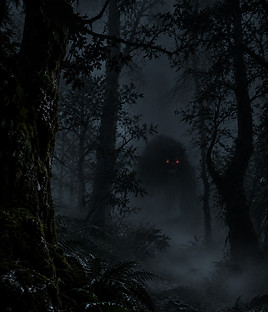
While the population across all of Galicia is dying out, decimated by famine, the reality in San Mamede is disturbingly different. The granaries and lofts are filled to the ceiling, the tables in the houses are always laid out with food, and the neighbors eat copiously. No one tells the outsider comisario anything, yet they deny him nothing either: they serve him overflowing plates in silence, doing nothing but stare at him while he eats.
Martiño faces an inescapable countdown: he must find out before All Souls' Night what kind of aberrant entity has sat down to dine at the tables of San Mamede's inhabitants. His only support in that cursed land will be scarce: a lonely girl who watches him from the cliffs and distrusts everyone, a cruceiro viciously desecrated in the middle of the mountain, and an old woman living deep within the forest who holds far more secrets in her memory than she confesses.
What will you discover between the pages of this first volume?
-
A slow-burn horror: A claustrophobic mystery and investigation plot set in a hermetic community where every display of kindness feels like a subtle death threat.
-
The Costa da Morte in its purest form: Perpetual mists, gorse fields, the harsh shellfish gathering during low tide, and the dark reality of deliberate shipwrecks off the capes.
-
An unforgiving historical chronicle: The real Galicia of 1649 portrayed with its wartime conflicts, devastating famines, the crushing weight of the Church, and its characteristic dialect.
-
An authentic folklore monster: A horror drawn directly from Galician legends, whose name we will not reveal to keep the reading mystery completely intact.
Upcoming Volumes in the Saga (Already Planned)

Vol. II — The King of the Dead: Set in Santiago de Compostela during Lent, 1651. Terrified locals whisper about flickering lights marching in procession in the dead of night, a persistent smell of wax clinging to clothes, and deceased souls walking once more through the labyrinth of wet granite. The Holy Company roams the city of pilgrims, and it does not travel alone. After a fellow inspector is found dead at the doors of the headquarters—grave mud on his legs and a melted candle in his hand—Martiño (the only one who has seen the Company and lived to tell the tale) must hunt down the King of the Dead before Holy Week, while a presence uses the voice of the person he misses most in this world to tempt him.
Vol. III — Howls on the Border: Martiño is sent back to the Miño River border, where he fought for six years and where he hides what he witnessed on the final night of the war. Between abandoned trenches and villages ravaged by armies, shepherds and livestock are turning up torn to pieces. The elders speak of the werewolf, and surviving soldiers claim that this beast has been tracking the path of the war for years... and that now, it is specifically asking for a soldier named Martiño.
Vol. IV — The Revenge of the Witches: In a region of dense, enclosed mountains and thick oak forests, the healers and women who healed with words begin to turn up murdered one by one. Shortly after, the men who denounced them to the Inquisition begin to fall, followed by their children. Sent to a place where the Holy Office left a bloody mark years ago, Martiño will encounter a hostile village nailing gorse branches to their doorsteps. This time, he will have to decide whether justice is on the side of the victims or the Church he serves.
Vol. V — Lenten Blood: The children of the poorest families in Santiago begin to wake up pale, with a small mark on their chests, languishing until they die within a week. Myth speaks of the life-sucker, the witch who slips through keyholes in the form of a fly to drain their life force. Fear unleashes collective hysteria and the city demands bonfires, hunting down widows and healers. Martiño knows that witches are not responsible and that someone in the highest echelons is manipulating the terror of the masses; a monster that does not hide in the forests, but blesses the people dressed in silk from the main balconies.